

timeline: where attention spikes, where it falls off, and which brain network is doing the work at each moment. (The “64 / C” you see in the app is just the average of that curve; the API hands you the whole curve.)
This page walks through one scan end to end, frame by frame. The video frame at each key second sits next to the readout the model produced for that second, so you can literally see “at 0:03 the shot is this, here’s the response, and here’s why.”
This walkthrough uses Qualia, the current model, on a video reel. (Qualia is the default and only available model right now; Mary is temporarily unavailable.) The numbers below are an illustrative example chosen to show how to read a curve; treat the absolute decimals and percentiles as a worked example, not fixed values you’ll see on every scan.
The scan
Score 64, Grade C
A 60-second vertical reel. “Okay” tier: a solid hook with a gentle fade.
Top network
Emotion & reward (Limbic) leads the whole way, with Reasoning & effort close behind.
Peak 0:03, Low 0:58
Every lens peaks at second 3 and bottoms out at second 58.
moments block listing the standout seconds: the peaks and the lows. For this reel the peaks cluster at the very start (seconds 1 to 6) and the lows cluster at the very end (seconds 56 to 59). We’ll visualize the strongest peak, a sustained-peak second, a mid-reel baseline, and the deepest low.
The per-second values below are the model’s raw network activations (roughly 0.14 to 0.19 here). They’re a relative signal: what matters is how they move across the timeline and which network sits on top, not the absolute decimal.
0:03, the peak

Frame at 0:03: speaker with B-roll cut-in, caption 'will mint'
This is the high point of the entire reel. Every KPI hits its maximum here, in the top percentile for this clip.
Top network: Emotion & reward (Limbic),
0.189, the strongest single activation in the scan.Why: the hook lands. A face delivering a claim, a fast B-roll cut-in, and on-screen text all arrive at once, and the model reads this as the moment of peak emotional pull and reward anticipation.Benchmark: peak second of the reel.0:06, sustained peak

Frame at 0:06: tight face shot, caption 'no one is paying'
Still in peak territory, near the top of the clip. The hook hasn’t worn off yet.
Top network: Emotion & reward (Limbic),
0.188, with Reasoning & effort (Frontoparietal) right behind at 0.185.Why: a direct-to-camera claim (“no one is paying”) keeps emotional salience high while the brain works to parse the statement. Effort and emotion firing together is the signature of an engaging hook.Benchmark: top-of-reel cluster (seconds 1 to 6).0:30, mid-reel baseline

Frame at 0:30: speaker with on-screen data table, caption 'Every major leap in'
The middle of the reel. This isn’t a flagged peak or low; it’s shown here as the steady-state baseline. Response has settled from the opening.
Top network: Emotion & reward (Limbic),
0.170, still leading but well off the 0.189 peak.Why: a dense information graphic appears over the speaker. Reasoning & effort stays engaged parsing it, but the novelty of the opening has faded, so overall activation drifts toward the reel’s average.Benchmark: mid-timeline baseline (this second is illustrative, chosen as a representative midpoint, not a flagged moment).0:58, the low
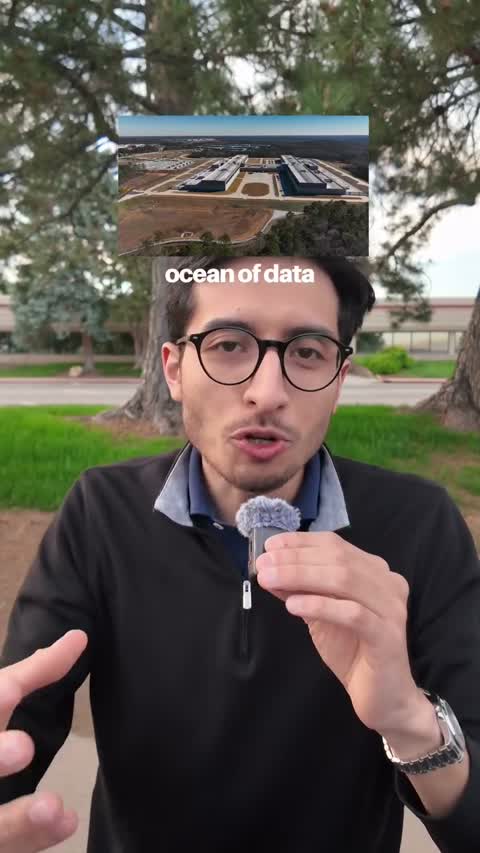
Frame at 0:58: aerial B-roll over speaker, caption 'ocean of data'
The deepest trough of the reel. Every KPI bottoms out here, in the bottom percentiles for this clip.
Top network: Emotion & reward (Limbic) still nominally leads at
0.150, but the whole cortex has cooled, well below the second-3 peak.Why: the reel is winding down. The payoff has already landed and the closing seconds carry less new information, so emotional pull and reward anticipation fall off. This is the classic “fade,” a candidate to tighten or re-cut if you want a stronger finish.Benchmark: low second of the reel.How to read this
1
Start with the shape, not the number
The 64 / C is the average. The story is the curve: a strong peak at 0:03, sustained through 0:06, then a long, smooth decline to the trough at 0:58.
2
Find the peaks and lows in moments
Don’t eyeball the whole clip by hand. The
moments block already names the standout seconds and their percentiles, so jump straight there.3
Read the top network to learn *why*
Emotion & reward (Limbic) leading throughout tells you this content works by feeling, not by visual spectacle. Visual sits near the bottom every second.
4
Act on the gap between peak and low
A great hook (0:03) and a soft ending (0:58) is the most common pattern. Tightening the final seconds is usually the highest-leverage edit.
Reading a scan
The field-by-field guide to the scan object:
timeline, per-second scores, raw networks, moments, and summary.